Author: JD Pro Build
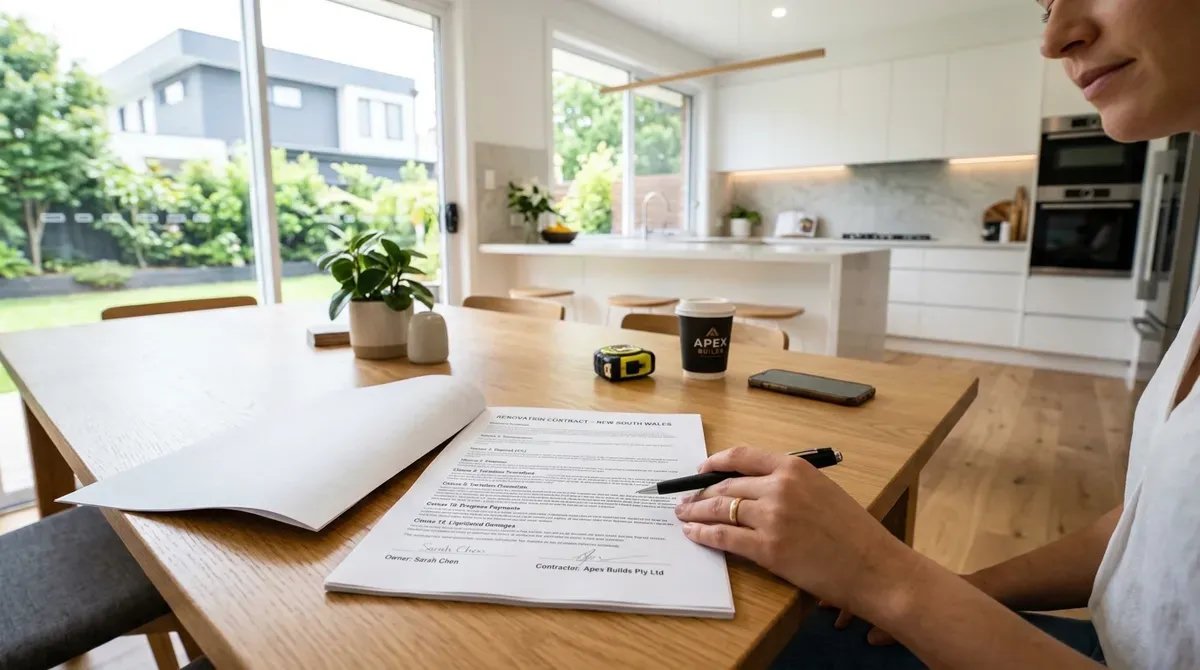
Planning a renovation in New South Wales is exciting—but it also involves serious legal and financial commitments. At JD Pro Build, we regularly meet homeowners in Sydney who feel overwhelmed when they open their renovation contract for the first time. The legal terms, payment schedules, and conditions can all seem confusing.
Yet your renovation contract is the single most important document for protecting your home, your money, and your peace of mind.
“In our experience, almost every serious renovation dispute we see starts with a contract that was rushed, vague, or never properly explained to the homeowner.”
— JD Pro Build, Sydney Renovation Specialists
This guide explains the key clauses in renovation contracts in NSW that every homeowner should understand before signing. You’ll learn:
- When a written contract is legally required in NSW
- The essential clauses every renovation contract should include
- How deposits, progress payments, and variations should be managed
- What warranties and protections you have under NSW law
- Common sources of disputes—and how to prevent them
- When and where to get professional help
By the end, you’ll know what to look for in your own contract so you can move forward with confidence.
Why Written Renovation Contracts Are Essential in NSW
Legal requirements for written contracts
In New South Wales, written contracts are not just a good idea—they are often a legal requirement.
Under the Home Building Act 1989 (NSW):
- A written contract must cover residential building work over $5,000 (including labour and materials).
- Residential building work over $20,000 requires a more detailed home building contract that includes specific mandatory information.
A verbal agreement or a simple quote is not enough for these types of projects.
According to NSW Fair Trading, written home building contracts must clearly set out key details such as:
- The scope of work
- The contract price or a warning that the price is not fixed
- The amount of any deposit and progress payments
- The start and finish dates (or how they will be determined)
- A clear process for variations
“For most residential building work over $5,000, the law requires a written contract.”
— NSW Fair Trading, Home Building Contracts Guidance
If your builder is suggesting that a handshake, SMS, or email trail is enough for a large renovation, that’s a warning sign. A proper written contract is there to protect both parties.
No payment before a compliant contract is signed
In NSW, builders cannot legally request or receive payment for residential building work that requires a written contract until a compliant contract has been signed by both parties.
This protects you from:
- Paying money before clear terms are in place
- Being pressured to transfer a “goodwill” payment or “booking fee” with no formal agreement
- Starting work based on assumptions rather than documented obligations
Banks and lenders will also typically refuse to release construction funds unless they have a copy of a properly executed contract.

Written contracts protect both homeowner and builder
A well-drafted contract is a safety net for everyone involved. When we prepare contracts at JD Pro Build, our goal is always mutual protection.
A good renovation contract should:
- Make sure builders are paid fairly and on time for the work they perform
- Protect homeowners from unjustified price increases or incomplete work
- Allocate risk clearly (for example, what happens if material prices rise or unknown structural issues appear?)
- Prevent misunderstandings over what is and is not included in the price
When expectations are clear and fair from day one, projects tend to run more smoothly, with less stress for everyone.
A single source of truth during the build
Renovations involve hundreds of decisions: layouts, fixtures, finishes, structural details, services, and more. Without a clear, written agreement, it’s easy for misunderstandings to arise.
Your contract, together with the approved plans and specifications, should act as the single source of truth for your project:
- What exactly is being built
- Which materials and brands are included
- Which items are excluded or treated as allowances
- How changes must be handled and priced
If a disagreement arises—about tapware style, tile size, or what is included in the scope—you should be able to refer back to the signed documents for clarity.
Key Clauses in NSW Renovation Contracts
Not all renovation contracts are the same, but there are several clauses that almost every homeowner in NSW should pay particular attention to.
Scope of work and exclusions
The scope of work is one of the most important parts of your residential building contract in NSW. It should clearly describe what your builder will construct, supply, and deliver.
A strong scope of work typically:
- Refers to architectural plans, engineering drawings, and any council or private certifier approvals
- Describes each major area of work (e.g., kitchen renovation, bathroom renovation, structural alterations, extensions)
- Lists the key tasks the builder is responsible for (demolition, framing, waterproofing, tiling, painting, etc.)
- Specifies whether certain preparatory works (e.g., asbestos removal, pest treatment, major structural repairs) are included or excluded
Vague descriptions like “renovate bathroom” or “update kitchen” leave too much room for interpretation. That’s where disputes often start.
The contract should also set out exclusions—what the builder is not responsible for. Common exclusions include:
- Landscaping and garden works
- Driveway works or external paving
- Window furnishings (curtains, blinds)
- Standalone appliances (fridge, washer, dryer)
At JD Pro Build, we always walk our clients through the scope line by line. It often surprises homeowners how much clarity this simple step adds, and how many small assumptions we can catch and clarify before they turn into issues on site.

Price, deposits, and progress payments
Understanding the price structure in your contract is essential for managing your renovation budget.
Fixed-price vs cost-plus contracts
Most residential renovations in NSW use a fixed-price contract, where the total price is agreed upfront (subject to variations and allowances). This gives families more certainty.
A cost-plus contract, by contrast, charges you for:
- Actual labour
- Actual materials
- Plus an agreed margin or fee
Cost-plus contracts can be appropriate for certain complex or highly uncertain projects, but they require very careful management and trust, as the final price is not known at the start.
If your contract is not clearly fixed-price, make sure you understand exactly how the final amount will be calculated.
Legal limits on deposits in NSW
NSW law strictly limits how much a builder can request as a deposit for residential building work:
- For work between $5,000 and $20,000, the maximum deposit is 10% of the contract price.
- For work over $20,000, the maximum deposit is 5% of the contract price.
If a builder is asking for more than this, you should treat that as a serious concern and seek advice.
Progress payment schedule
Your contract should include a clear schedule of progress payments linked to specific stages of completion. Common stages include:
- Base or slab
- Frame
- Lock-up
- Fixing
- Practical completion
Each payment should be triggered only when the relevant stage is genuinely completed. Often, lenders will send an independent inspector to confirm progress before releasing funds.
This structure helps ensure that:
- You only pay for work that has actually been completed
- The builder maintains strong motivation to keep the project moving
- Your cash flow remains under control throughout the build
Timelines, delays, and Extensions of Time (EOT)
Every renovation contract in NSW should deal clearly with timeframes and delays.
Key points to check include:
- Start (commencement) date or how it will be determined
- Practical completion date, or a method for calculating it
- Definition of practical completion (usually when the home is reasonably fit for occupation, even if minor defects remain)
Extensions of Time (EOT)
Construction projects can face genuine delays beyond the builder’s control. Your contract should explain when the builder can claim an Extension of Time, and what the process is. Typical valid reasons include:
- Severe or unsafe weather
- Industry-wide material shortages
- Delays caused by statutory authorities or councils
- Delays caused by the owner (late selections, late approvals, late payments)
Good contracts require the builder to:
- Notify you in writing when claiming an EOT
- Explain the reason and the number of additional days sought
This transparency helps avoid arguments about whether a delay is genuine and who is responsible.
Liquidated Damages
This might specify a daily or weekly amount that the builder must pay if they fail to reach practical completion by the agreed date, and the delay is not covered by a valid EOT.
For example:
- The contract may state that the builder will pay $250 per week if they run late without a valid cause, helping to offset extra rent or accommodation costs.
Liquidated damages must be reasonable and represent a genuine pre-estimate of your likely loss. If you’re unsure about what’s reasonable for your project, it’s wise to seek legal advice.
Variations: controlling changes and budget blowouts
Variations are any agreed changes to the scope of work, materials, or specifications after the contract has been signed.
In our experience, variations are one of the biggest sources of budget blowouts in home renovations.
Common causes include:
- Homeowners upgrading fixtures and finishes mid-project
- Hidden conditions discovered after demolition (e.g. termite damage, rotten framing, asbestos)
- Changes to layout or structure during construction
Under NSW law, builders generally cannot charge for variations unless they have been properly documented and approved in writing by the homeowner before the additional work starts.
A clear variations process should:
- Set out the reason for the change
- Describe the additional or changed work
- State the extra cost or reduction in price
- Explain any impact on the timeframe
- Require both parties to sign or formally approve the change
At JD Pro Build, we follow a strict written variation process for every project. This protects our clients from surprise invoices and gives everyone a clear record of what was requested and why.
We also recommend homeowners keep a contingency fund of around 10–15% of the contract price for genuine unforeseen issues.
Warranties, defects liability, and Home Building Compensation (HBC)
Your renovation contract in NSW should set out the warranties and defects liability period that apply to the work.
Under NSW law, statutory warranties generally provide that:
- Major defects (for example, serious structural issues) are covered for 6 years from completion.
- Other defects (for example, minor non-structural issues) are covered for 2 years.
These statutory warranties apply by law, even if they are not written in the contract, but good contracts will spell them out clearly.

Defects liability period
Most renovation contracts provide for a defects liability period immediately after practical completion. This is typically between 13 and 26 weeks.
During this period, the builder is responsible for returning to the property to fix minor defects that become apparent in normal use—for example:
- Minor cracking from settlement
- Sticking doors or windows
- Small paint touch-ups
We recommend that homeowners:
- Keep a detailed list of defects and issues as they appear
- Provide the list in writing before the end of the defects liability period
A good builder will handle this professionally and see it as part of completing the project properly.
Home Building Compensation (HBC)
For most residential building work in NSW over $20,000, builders must obtain Home Building Compensation (HBC) cover (previously known as Home Warranty Insurance) and provide a valid certificate to the owner before:
- Taking any deposit, and
- Starting any work on site
HBC is designed to protect homeowners if the builder:
- Dies
- Disappears
- Becomes insolvent, or
- Has their licence suspended for failing to comply with a Tribunal or Court order
You should never pay a deposit or allow work to begin without sighting and confirming the HBC certificate for your project.
Common Renovation Contract Disputes and How to Avoid Them
Unfortunately, we are often called in to advise homeowners who are already in disagreement with their builder—sometimes over issues that could have been prevented with clearer documentation and communication at the start.
Setting clear expectations from day one
Many disputes stem from expectations that were never properly discussed or documented.
Important topics to cover with your builder include:
- Working hours and access to the site
- How and when you will receive progress updates
- How unexpected findings (like termite damage or asbestos) will be handled
- What decisions you must make and by when (e.g. tile selection, tapware, appliances)
Talking through these practical details openly can prevent misaligned assumptions later.
At JD Pro Build, we always schedule a comprehensive pre-construction meeting to:
- Confirm expectations on both sides
- Walk through the key contract clauses in plain English
- Highlight where we’ve seen issues arise on other projects
This early investment of time consistently saves stress later.
The power of written communication
Relying on quick verbal comments on a busy building site is risky. Details can be misunderstood or forgotten.
A simple habit that protects homeowners is to confirm important discussions in writing, for example by email. For instance:
- If you change a paint colour
- If you agree to an alternative tile because the original is out of stock
- If you approve a small variation suggested on site
Brief, written follow-ups create a clear record of what was agreed. If a formal variation is needed, it should be documented in line with the contract.
“If you’re not willing to put it in writing, you probably shouldn’t rely on it in a building dispute.”
— Common advice from NSW construction lawyers
We also recommend keeping all project documents in a dedicated digital folder—contracts, emails, site photos, invoices, and variation approvals.
Managing provisional sums and prime cost items
Prime cost items and provisional sums are another frequent cause of budget stress.
- Prime cost items are allowances for fixtures or fittings where you haven’t yet selected the exact product (for example, ‘oven – prime cost $1,000’).
- Provisional sums are allowances for work where the exact cost is unknown at the time of signing (for example, excavation in unknown ground conditions).
If these allowances are set too low, your actual costs may be much higher once real products are chosen or real conditions are discovered.
To reduce the risk of surprises:
- Ask your builder how they calculated the allowances
- Try to make as many selections as possible before signing the contract
- Understand that any amount over the allowance will be an extra cost
At JD Pro Build, we work hard to make our allowances realistic based on current market pricing and our experience on similar projects across Sydney.
Where to Get Help and Advice in NSW
When to speak to a construction lawyer
Renovation contracts involve significant financial and legal commitments. For larger or more complex projects, we strongly recommend that homeowners seek independent legal advice.
Consider speaking to a construction lawyer if:
- Your contract value is high (for example, a major extension or full-home renovation)
- You do not understand some terms, or they seem one-sided
- The builder is asking for a deposit higher than allowed by law
- The builder is unwilling to properly document variations or payment schedules
- You are already in dispute or concerned about serious defects or delays
A construction lawyer can:
- Review your contract and explain it in plain English
- Suggest amendments to better protect your interests
- Advise you on your options if things go wrong
While this is an extra upfront cost, it can save a great deal of stress and money later.
Using NSW Fair Trading resources
The NSW Fair Trading website offers a range of helpful resources for homeowners, including:
Guides to home building contracts in NSW
- Example contract checklists
- Information about statutory warranties and HBC cover
- A free dispute resolution service for certain types of building disputes
Before signing any contract, it’s wise to review their latest guidance so you are familiar with your rights and obligations as a homeowner in NSW.
Handling disputes and escalation
If you encounter difficulties with your builder, a sensible escalation path often looks like this:
- Start by raising your concerns directly with the builder in writing, referring to the contract
- If issues remain unresolved, explore the dispute resolution services offered by NSW Fair Trading
- For complex or serious disputes, consult a construction lawyer to understand your legal options, which may include proceedings in NCAT (NSW Civil and Administrative Tribunal) or other forums
Always keep detailed records of communications, site conditions, invoices, and any expert reports.
This guide provides general information only and does not constitute legal advice. Laws and regulations can change, and every project is different. You should obtain independent legal advice before signing any home building contract.
How JD Pro Build Approaches Clear, Fair Contracts
At JD Pro Build, we believe that a clear, fair contract is the foundation of a successful renovation.
Plain-English explanations
We know most homeowners are not lawyers—and shouldn’t need to be. That’s why our standard approach includes:
- Walking you through each major clause in plain English
- Explaining how deposits, progress payments, variations, and time extensions work in practice
- Highlighting any areas where we recommend you seek independent legal advice
Many of our clients have told us that this is the first time they truly understood a building contract they were signing.
Transparent pricing and variations
We are committed to transparent pricing with no hidden fees. Our contracts:
- Clearly set out what is included and excluded in the scope
- Use realistic allowances for prime cost items and provisional sums
- Require written approval for all variations before additional work proceeds
- This protects your budget and gives you confidence that there will be no unexpected last-minute surprises.
Respecting legal requirements and consumer protections
We strictly follow NSW legal requirements, including:
- Complying with maximum deposit rules
- Providing Home Building Compensation (HBC) cover where required before taking any deposit
- Honouring statutory warranties and defect rectification obligations
We treat your property with the same care and seriousness as we would our own homes.
Practical Checklist Before You Sign a Renovation Contract in NSW
Before committing to a renovation contract, take the time to work through a simple but powerful checklist:
- Confirm that the project value and type of work require a written contract under NSW law.
- Check that the builder is licensed and that you have sighted their licence details.
- Review the scope of work and exclusions carefully—do they match your understanding and drawings?
- Confirm whether the contract is fixed-price or cost-plus, and how the final price will be calculated.
- Ensure the deposit is within NSW legal limits (5% or 10%, depending on the contract value).
- Review the progress payment schedule and confirm payments are tied to clear stages of completion.
- Check how variations will be handled, documented, and priced.
- Understand the timeline, Extensions of Time (EOT), and any liquidated damages provisions.
- Confirm the warranties, defects liability period, and HBC cover (if required) are properly documented.
- Consider having a construction lawyer review the contract if the value or complexity justifies it.
If any part of your contract makes you feel uncomfortable, do not rush. Ask questions, seek clarification, and get independent advice where needed.
Next Steps: Talk to a Sydney Builder Who Welcomes Questions
Understanding your renovation contract in NSW is one of the best investments you can make in your property.
When you partner with a builder who values clear communication and fair documentation, you can focus on the exciting part—designing and enjoying your improved home—instead of worrying about fine print.
At JD Pro Build, we:
- Take the time to explain our contracts in detail
- Encourage you to ask as many questions as you need
- Welcome the involvement of your own legal advisor
- Provide realistic pricing and transparent variation processes
If you are planning a renovation in Sydney or surrounding areas and would like to discuss your project—and your contract options—we invite you to book a no-obligation consultation with our team.
Together, we can help you:
- Clarify your renovation goals and budget
- Understand the key contract clauses that will apply to your project
- Plan a pathway to a safe, well-documented, and successful build
Your home is one of your most important investments. With the right contract and the right team, you can renovate with confidence.