

Living through a renovation can be exciting, stressful, messy, and rewarding all at once. For many Sydney families, the biggest challenge is not choosing tiles or finishes — it is keeping daily life running while part of the home becomes an active work site.
This guide explains how to plan ahead, reduce disruption, protect children and pets, manage dust and noise, and communicate clearly with your builder. It is based on the way JD PRO BUILD helps Sydney homeowners prepare for renovations across bathrooms, kitchens, home upgrades, and granny flat projects.
Can You Live at Home During a Renovation?
In many cases, yes — you can live at home during a renovation. But whether you should depends on the size of the project, your family situation, the number of working bathrooms, and how much dust, noise, and temporary inconvenience you can realistically tolerate.
For a smaller bathroom renovation or kitchen renovation, staying at home may be manageable with the right preparation. For larger structural renovations, multiple wet-area upgrades, or major internal works, moving out temporarily may be safer and less stressful.
At JD PRO BUILD, we often advise homeowners to think about three things before deciding:
- Will you still have a safe place to sleep, cook, and shower?
- Will children, pets, or elderly family members be exposed to unsafe work areas?
- Can your family cope with early starts, dust, trades, noise, and limited access?
If the answer to any of these is uncertain, speak with your builder before work starts. A clear construction schedule can help you decide whether to stay, move out, or only leave during the most disruptive stages.
Stay or Move Out? A Practical Decision Guide
Every family has a different tolerance for disruption. The right choice is not always about cost — it is about safety, comfort, and daily routine.
| Renovation Situation | Staying Home During Renovation May Be Suitable If… | Moving Out During Renovation Is Often the Better Option |
|---|---|---|
| One bathroom renovation | You have a second fully functioning bathroom available for daily use. | Not usually necessary unless access to the remaining bathroom is limited. |
| Only bathroom is being renovated | Generally not practical because essential facilities will be unavailable. | Recommended to maintain access to a working bathroom throughout the project. |
| Kitchen renovation | A temporary cooking area with basic appliances can help you stay comfortably at home. | Consider moving out if you cannot prepare meals or the disruption is significant. |
| Whole-home renovation | Suitable only for minor staged works that leave key living areas usable. | Recommended when multiple rooms are under construction at the same time. |
| Structural work or major demolition | Possible only for very limited work with effective dust and noise control. | Recommended due to heavy dust, noise, restricted access, and safety considerations. |
| Homes with young children, elderly residents, or people with respiratory conditions | May be possible for small projects with minimal disruption. | Often the safer choice because construction dust and noise can affect health and comfort. |
| Homes with pets | Suitable if pets can remain calm around noise, workers, and temporary changes. | Often a better option for pets that are sensitive to loud sounds, unfamiliar people, or restricted spaces. |
| Apartment or strata renovation | Often possible if building access remains convenient and disruption is limited. | May be preferable if access restrictions, lift bookings, or strata by-laws significantly affect daily living. |
A short-term rental can add cost, especially in Sydney, but living in the home can also create hidden costs such as takeaway meals, storage, laundromats, cleaning, and time away from work.
Before choosing, ask your builder for a week-by-week outline showing when the home will be loudest, dustiest, or without access to essential areas.
What to Do Before Renovation Work Starts
Good preparation makes the renovation feel more controlled from day one. The goal is to reduce the number of daily surprises once trades arrive.
Create a Master Schedule
Ask your builder for a simple timeline showing the main phases of work. You do not need every small task, but you should know the likely timing of:
- Demolition
- Plumbing and electrical rough-in
- Waterproofing
- Tiling
- Cabinetry or joinery installation
- Painting
- Fit-off
- Final clean and handover
This helps you plan school runs, work-from-home days, family outings, deliveries, and any temporary accommodation.

Pack Like You Are Moving
Renovation dust travels further than most homeowners expect. Before work begins, remove non-essential items from the work zone and nearby rooms.
Before renovation begins, pack away any items that could be damaged by dust, moisture, or accidental impact. This includes books, soft furnishings, rugs, children’s toys, electronics, decorative pieces, and any sentimental or fragile belongings. Storing these items in sealed boxes or moving them to a safe area helps protect your possessions and makes the renovation process safer and more efficient.
If the renovation is large, consider temporary storage for furniture. A clearer home is easier to protect, clean, and live in.
Set Up a Clean Zone
Choose one room that will stay separate from the work area. This becomes your family’s calm space during the renovation.
A good clean zone should have:
- Comfortable seating
- Basic storage
- Chargers
- Children’s activities
- Work-from-home essentials
- Doors or barriers to reduce dust
From our experience on Sydney renovation sites, families cope much better when they have at least one room that still feels normal at the end of the day.
How to Set Up a Temporary Kitchen
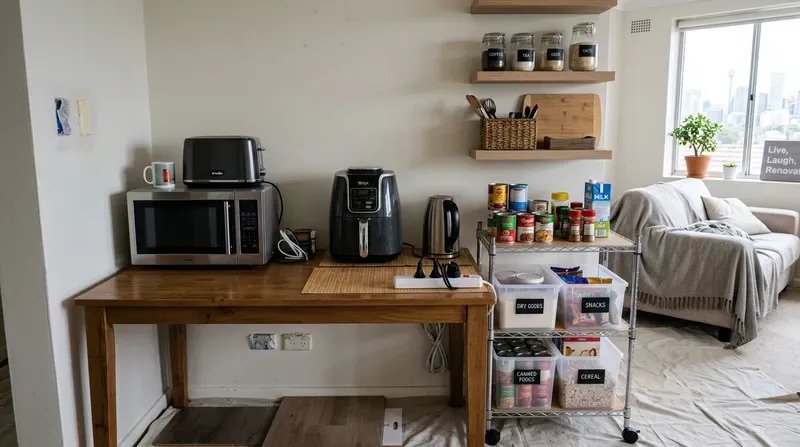
If your kitchen is being renovated, your temporary kitchen does not need to be perfect. It only needs to be safe, clean, and practical enough for a few weeks.
Choose a spare room, laundry, garage, or covered area away from dust. Then set up a simple cooking station with:
- Microwave
- Kettle
- Toaster
- Air fryer
- Slow cooker
- Mini-fridge or spare fridge
- Folding table
- Storage tubs
- Basic plates, cups, and cutlery
- Sealed containers for pantry items
Keep meals simple. This is not the time for complicated cooking. One-pan meals, reheatable dinners, slow-cooker meals, and occasional takeaway can make the renovation period much easier.
How to Manage Bathroom, Laundry, and Plumbing Access
Bathroom access is one of the biggest stress points during a renovation. If you have two bathrooms, ask your builder whether one can remain usable while the other is renovated.
If you only have one bathroom, plan for the days when it may be completely unavailable. Options may include:
- Staying with family nearby
- Booking short-term accommodation
- Using a gym shower
- Hiring a portable ensuite
- Scheduling time away during demolition or waterproofing
Laundry can also become difficult. Before work starts, wash bulky items such as bedding, towels, school uniforms, and workwear. During peak disruption, a local laundromat or wash-and-fold service may save a lot of stress.
How to Manage Dust During a Renovation
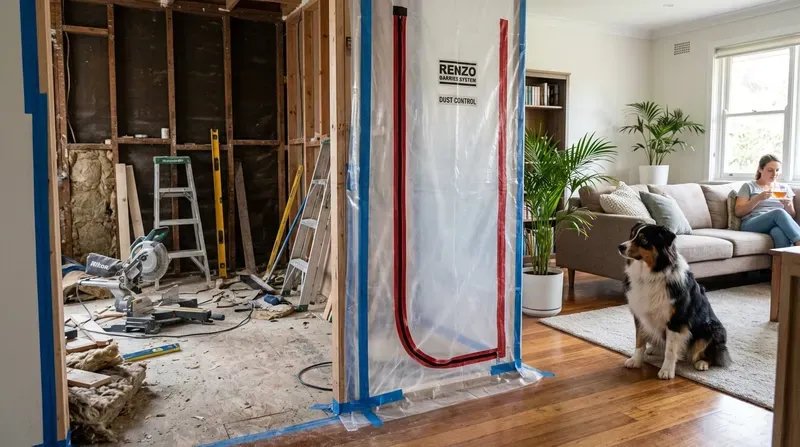
Dust control is not just about keeping the home clean. It is also about comfort, health, and safety.
Some renovation work can create fine dust from materials such as concrete, brick, tiles, mortar, fibre-cement sheeting, and stone. SafeWork NSW notes that crystalline silica is found in many common building materials, including bricks, concrete, tiles, mortar, and fibre-cement sheeting.
“Crystalline silica is found in stone, rock, sand, gravel and clay, as well as products such as bricks, tiles, concrete and some plastic materials.” — SafeWork NSW
To reduce dust spreading through the home, ask your builder about:
- Dust barriers or zip walls
- Sealing doors and vents near the work zone
- Wet cutting where appropriate
- On-tool dust extraction
- Industrial vacuums
- Daily clean-up routines
- Keeping children and pets out of dusty areas
SafeWork NSW guidance also highlights controls such as wet methods, on-tool dust extraction, exclusion zones, and suitable respiratory protection for high-risk silica work.
As a homeowner, you should not need to manage the worksite yourself. But you should feel comfortable asking how dust will be controlled before work begins.
How to Reduce Noise and Daily Disruption
Noise is part of renovation work, especially during demolition, drilling, cutting, framing, and rough-in. The key is not to eliminate noise — it is to know when it is coming.
Ask your builder:
Which days will be the loudest?
What time will trades usually arrive?
Will there be jackhammering or concrete cutting?
Can very loud work be grouped into certain days?
Will neighbours be notified before major noisy work?
In NSW, construction noise rules are usually managed through council conditions or local regulation. The NSW EPA explains that councils and police commonly handle neighbourhood noise issues. Many council construction conditions also use standard hours, such as weekday daytime work and limited Saturday work, with no noisy work on Sundays or public holidays, although exact rules vary by council.
“Local council and NSW Police generally regulate neighbourhood noise.” — NSW EPA
If your children nap during the day, or if you work from home, plan around the loudest stages. Sometimes the best strategy is simple: leave the house during demolition, take calls elsewhere, or schedule family activities outside the home.
Safety Tips for Children, Pets, and Elderly Family Members
A renovation site should never be treated like a normal room in the home. Even after trades leave for the day, there may be tools, sharp edges, wet surfaces, temporary wiring, loose materials, or uneven flooring.
Set clear rules from the beginning:
- Children must not enter the work zone.
- Pets should be kept in a secure area.
- No one should touch tools, materials, ladders, or temporary barriers.
- Family members should use only the agreed access paths.
- Any concern should be raised with the site manager, not individual trades.
If someone in the home has asthma, allergies, mobility concerns, or respiratory issues, discuss this with your builder early. Extra separation, ventilation, cleaning, or temporary relocation may be needed during dusty stages.
At JD PRO BUILD, we believe a family renovation should be planned around the people living in the home — not just the building work itself.
Sydney-Specific Renovation Issues to Plan For
Renovating in Sydney comes with practical challenges that may not apply in every location. Homes are often close together, parking is limited, access can be tight, and many properties are affected by strata, council, or heritage requirements.
Before work starts, consider:
- Where trades will park
- Where materials will be delivered
- How neighbours will be notified
- Whether lift protection or booking is required
- Whether your renovation needs council approval, CDC, or DA
The NSW Planning system explains that complying development is a fast-track approval pathway for certain straightforward projects that meet set standards. However, not every renovation qualifies. Some projects may be exempt, some may be complying development, and others may need a full development application.
“Complying development is a fast-track approval process for straightforward residential, commercial and industrial development.” — NSW Department of Planning
If you are unsure, ask your builder, certifier, or local council before assuming approval is not required.
Communication With Your Builder
Clear communication is one of the most important parts of living through a renovation. Even a well-managed project can feel stressful if you do not know what is happening next.
Agree on one main point of contact before work begins. This may be the builder, project manager, or site supervisor.
At JD PRO BUILD, we have found that families feel far more relaxed when they know what is happening today, what is happening next, and who to speak to if something changes.
Budget, Variations, and Written Approvals
Living through a renovation becomes much harder when costs feel unclear. Before work starts, make sure your quote, inclusions, exclusions, and allowances are easy to understand.
NSW Fair Trading states that residential building work between $5,000 and $20,000 must use a small jobs contract, while work over $20,000 requires a more detailed home building contract.
NSW Fair Trading also explains that variations should be in writing, describe the change, set out the price change, and be signed by both parties.
“Make sure you understand the procedure for variations to the contract.” — NSW Fair Trading Contract Checklist
Before approving any change, ask:
- What exactly is changing?
- How much will it cost?
- Will it affect the timeline?
- Does it affect other parts of the renovation?
- Can I have the variation in writing?
This keeps the project transparent and helps avoid tension later.
The Hardest Renovation Stages to Live Through
Not every stage of a renovation feels the same. Some weeks are loud and dusty; others are quieter but still inconvenient.
| Renovation Stage | Disruption Level | What to Expect |
|---|---|---|
| Demolition | Very high | Heavy noise, dust, debris, restricted access |
| Rough-in | High | Plumbing and electrical work, walls, and floors were opened |
| Waterproofing | High | Bathroom closed while waterproofing cures |
| Tiling | Medium | Tile cutting, dust, adhesive, and grout drying |
| Cabinetry installation | Medium | Joinery installation and reduced working space |
| Painting | Medium | Paint odours and increased ventilation |
| Fit-off | Medium | Fixtures, appliances, and fittings installed and tested |
| Final clean & handover | Low | Cleaning, defect inspection, and final walkthrough |
If you can only leave the home for a short period, demolition and major dusty work are usually the best stages to avoid.
Final Handover Checklist
Before you fully return to normal use of the renovated area, walk through the finished space carefully with your builder.
Before signing off on your renovation, check that all taps, mixers, drains, toilets, exhaust fans, lights, power points, cabinet doors, drawers, and appliances are working correctly. Also, inspect the tile grout, silicone joints, paint finish, and the operation of all doors and windows, and make sure you receive any applicable waterproofing or compliance certificates, warranty documents, and care instructions for your new fixtures and finishes.
Do not rush this stage. A good handover gives you confidence that the work is complete, functional, and ready for daily family life.
Renovation Survival Checklist for Sydney Families
Use this checklist before your renovation begins:
- Decide whether to stay home or move out.
- Ask for a clear project schedule.
- Confirm when water, power, or room access may be interrupted.
- Pack away non-essential belongings.
- Create a clean zone for the family.
- Set up a temporary kitchen if needed.
- Keep children and pets away from work zones.
- Check approval, strata, parking, and access requirements.
FAQs About Living Through a Renovation
Can you live in a house during renovation?
Yes, you can live in a house during renovation if there are safe, separate living areas and essential services remain available. It is easier during smaller renovations and harder during major structural or whole-home projects.
Is it safe to stay home during a bathroom renovation?
It can be safe if the work zone is properly separated, dust is controlled, and you still have access to another bathroom. If it is your only bathroom, you may need temporary accommodation or another shower option.
How do you cook during a kitchen renovation?
Set up a temporary kitchen with a microwave, kettle, toaster, air fryer, slow cooker, mini-fridge, sealed food storage, and a clean preparation table.
How do you control dust during a renovation?
Use dust barriers, sealed doors, closed vents, industrial vacuums, wet cutting where appropriate, and daily cleaning. Ask your builder what dust-control systems will be used before work starts.
How do you protect children and pets during renovation work?
Create locked or clearly marked no-go zones. Keep children and pets away from tools, materials, open floors, temporary wiring, dust, and active work areas.
What should I ask my builder before work starts?
Ask about timeline, access, dust control, noise, water and power interruptions, site safety, communication, approvals, variations, warranties, and handover documents.
What is the most disruptive stage of renovation?
Demolition is usually the most disruptive stage because it creates the most noise, dust, movement, and waste. Rough-in and waterproofing can also affect access to bathrooms, kitchens, and utilities.
Do Sydney renovations need council approval?
Some works may be exempt, some may qualify as complying development, and others may need a development application. Check with your builder, certifier, or local council before starting.
Final Thoughts
Living through a renovation in Sydney is possible, but it works best when the project is planned around real family life. A clear schedule, safe boundaries, dust control, temporary living setups, and honest communication can make the process far less stressful.
The renovation period may feel inconvenient, but it is temporary. With the right builder and the right preparation, your family can get through the disruption and enjoy a home that is safer, more functional, and better suited to the way you live.
If you are planning a bathroom renovation, kitchen renovation, home upgrade, or granny flat project in Sydney, JD PRO BUILD can help you understand the likely timeline, disruption, access needs, and practical steps before construction begins.